 Journal
What 660nm actually does.
A short, annotated reading of the published research on red light and skin tissue. Mechanism first. Claims last, if at all.
Absorption
Light at 660 nanometres penetrates the upper layers of skin, where it is absorbed by cytochrome c oxidase, an enzyme in the mitochondrial respiratory chain. 1
Energy
Absorption is associated in published studies with increased ATP production, the energy currency cells use for maintenance and renewal. 2
Signal
Researchers describe this as photobiomodulation. Light as a signal to tissue, not a treatment applied onto it. 3
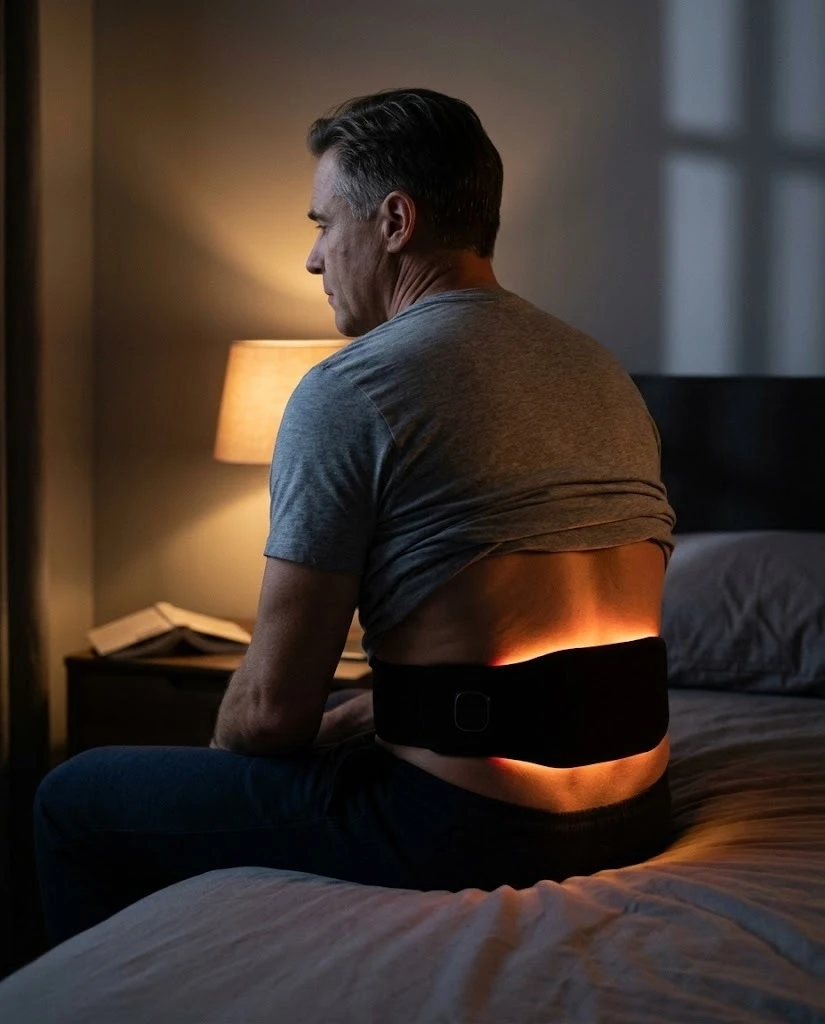
Fig. 1 · Restoration Belt
The array faces inward. In use, only the edge glow and the side control unit are visible. 630 to 660nm, calibrated to a twelve-minute session.
Read about the instrument →A biphasic dose response has been frequently observed where low levels of light have a much better effect on stimulating and repairing tissues than higher levels of light.
Huang, Chen, Carroll & Hamblin, Dose-Response 7(4), 2009
Mechanistic review of the light-dose literature
What it does not show — A review, not a trial. It does not tell you the optimal dose for any one device or any one face — only that 'more' stops helping and then starts hurting.
Verify on PubMed · PMID 20011653 ↗1. Hamblin, M. Mechanisms of low level light therapy. 2017.
2. de Freitas & Hamblin. Proposed mechanisms of photobiomodulation. 2016.
3. Anders et al. Low-level light/laser therapy versus photobiomodulation therapy. 2015.
Mechanism, at home.
Restoration Belt · €180. Once.
Order the Restoration Belt